Knowing how to vet a TikTok influencer before a brand collaboration protects more than media budget. It helps prevent audience mismatch, awkward sponsored content, avoidable brand-safety issues, and rights disputes after the video is delivered. A follower screenshot cannot do that work; the creator’s recent publishing history is the more useful starting point.
This guide gives brand and agency teams a seven-step creator due-diligence process. It uses public profile signals for initial screening and clearly separates them from private analytics that the creator must provide. Public data cannot prove follower authenticity, audience geography, watch time, or conversion performance.
Quick answer: what should a brand check before hiring a TikTok creator?
Define the campaign job first. Review 24–50 recent public videos for consistency, content fit, engagement quality, sponsorship history, competitor conflicts, and brand safety. Save evidence in a structured shortlist. Before contracting, verify audience demographics, geography, watch time, retention, previous campaign outcomes, usage rights, exclusivity, and disclosure requirements directly with the creator.
Vetting is not a universal score of a person’s value. A creator can be excellent and still be wrong for a specific product, market, risk level, or deliverable. Establish the decision rules before opening profiles so fame and personal taste do not quietly replace the brief.
| Decision area | Public profile evidence | Evidence to request privately |
|---|---|---|
| Creative fit | Topics, formats, voice, language | Production workflow and approval process |
| Reach consistency | Recent view distribution and cadence | Unique viewers and organic/paid context |
| Audience fit | Visible comments and cultural cues | Age, gender, geography, follower insights |
| Attention quality | Likes, comments, shares, reply behavior | Watch time, retention, completion rate |
| Business outcome | Public CTA and disclosed case examples | Clicks, leads, sales, code use, conversion |
Step 1: Define the campaign job and non-negotiables
Awareness, creator-led UGC, product education, app installs, and direct sales require different evidence. Write a measurable campaign job, such as “produce four believable product demonstrations for U.S. first-time renters” instead of “work with lifestyle creators.” This makes audience, content, and rights requirements easier to evaluate.
Split criteria into must-have, weighted, and optional. Market, language, restricted-category compliance, deadline, and brand-safety rules may be must-have. Preferred format, editing ability, or live experience can be weighted. Set those categories before viewing candidates and record who approved them.
Step 2: Review a representative recent sample
Use TikTok Profile Scan to collect the first 24 public posts. That is enough for efficient early screening. For finalists or higher-value collaborations, extend the sample to 24–50 posts or a date range that covers several weeks of normal publishing.
Do not rely on the creator’s three case-study links. Review high, median, and low performers, sponsored and organic posts, and how the creator behaves between viral moments. Consistency of voice and production matters when a brand needs predictable delivery, even if every video cannot be a breakout.
For a disciplined within-profile ranking, follow the guide to finding top-performing TikTok videos. When you need category benchmarks across several creators, use the 30-video TikTok account audit rather than comparing follower counts.
Step 3: Evaluate reach consistency and engagement quality
Calculate median views across the sample and look at the distribution. How many videos fall near the midpoint? How many exceed twice the median? Do sponsored posts consistently sit far below organic content? The median protects the review from one extreme viral outlier that inflates the average.
Public interactions need qualitative review. Comments containing relevant questions, personal experiences, and creator replies reveal more than rows of identical emojis. Shares on a practical tutorial may indicate utility; heavy comments on a polarizing opinion may signal controversy rather than campaign fit. Read enough conversation to understand why activity occurred.
Do not declare fake followers from a low view-to-follower ratio or one unusual spike. Public patterns can trigger a verification question, but they are not proof of manipulation. Use transparent evidence and allow the creator to provide context such as recent virality, paid support, or a shift in niche.
Step 4: Assess creative, audience, and commercial fit
Tag the creator’s recurring content pillars, strongest formats, dominant language, tone, price references, and audience problems. Ask whether your product can enter that content naturally. A skincare creator known for detailed routines may suit a demonstration brief; a comedy account with broad reach may struggle to deliver technical claims credibly.
Search recent posts for sponsorship disclosures, discount codes, review language, competitor products, and repeated brand categories. Study how the creator integrates a product: story, demonstration, scripted list, before-and-after, or testimonial. Confirm category exclusivity and prior competitive partnerships directly rather than inferring contract terms from public captions.
Visible comments and language are only audience clues. They cannot verify where followers live or their age distribution. Treat them as questions to investigate—“The discussion appears U.K.-focused; please share recent top territories”—not a substitute for analytics.
Step 5: Conduct a contextual brand-safety review
Define relevant risk categories before searching: hate or harassment, dangerous misinformation, adult content, unsafe behavior, regulated claims, non-disclosure, or direct conflicts with stated brand values. Review videos in context, including how the creator responds to criticism. Avoid treating a clipped sentence as a complete record.
Document a concern with URL, date, category, and a neutral description. Escalate serious or ambiguous cases to legal, compliance, or the designated brand-safety owner. Give the creator an opportunity to clarify when appropriate. Vetting should support a fair decision process, not produce public accusations.
Disclosure is part of safety and trust. The U.S. Federal Trade Commission publishes disclosure guidance for social media influencers; local requirements may differ, so the contract and brief should reflect every market in scope. Ask how sponsored content will be labeled before production begins.
Step 6: Build an evidence-backed creator shortlist
Create one summary row per candidate and link it to a detailed video sheet. Useful fields include username, profile URL, review date, sample size, median views, view range, cadence, top pillars, recurring formats, sponsorship notes, competitor conflicts, brand-safety notes, missing evidence, status, and reviewer.
Attach examples to claims. “Good content fit” is not auditable; “7 of 24 recent posts demonstrate renter-friendly organization, including three above 2x median views” is. Keep sensitive information to the minimum necessary and restrict workbook access according to your organization’s privacy practices.
If reviewers need offline reference copies, use the batch downloader only for an approved shortlist, retain source URLs, and limit redistribution. A public post does not give the brand permission to re-edit or advertise with the footage. The guide to reposting TikTok without a watermark also explains why ownership and clean files must be handled separately.
Step 7: Verify private metrics and commercial terms
Request only evidence tied to the campaign decision. Common items include audience territories, age and gender, follower growth, average watch time, completion rate, traffic sources, and outcomes from genuinely comparable collaborations. Ask for the date range, timezone, post type, and whether results included paid amplification.
A cropped screenshot of one best-ever post is not representative. For a large contract, ask for a screen recording or live analytics walkthrough and reconcile it with the campaign case study. Give the creator a secure way to share the information and state who will see it and how long it will be retained.
Commercial verification also covers deliverables, rounds of edits, timeline, disclosure, cancellation, category exclusivity, and usage rights. “One TikTok” does not automatically include whitelisting, paid media, website use, cutdowns, raw footage, or perpetual rights. Price those uses explicitly and document territory and term.
Sprout Social’s broader influencer vetting process is a useful strategic reference. The public-profile workflow here supplies an operational first layer; it does not replace contracts, legal review, or first-party analytics.
Use a three-way decision matrix
| Status | When it applies | Next action |
|---|---|---|
| Approve | Must-haves met, fit clear, risk acceptable, private evidence consistent | Finalize scope, rights, KPI, and brief |
| Verify | Promising fit but audience, conflict, or evidence remains incomplete | Send specific questions and a deadline |
| Reject | Audience mismatch, material conflict, unacceptable risk, or brief failure | Record an objective reason and close review |
Use weighted criteria, but allow true non-negotiables to remain pass/fail. A high follower count should not compensate for a prohibited claim or the wrong country. Record the decision owner and date, especially when a brand, agency, and legal team share responsibility.
Claims you should not make from public data
Do not say a creator has fake followers, a verified U.S. audience, excellent retention, or predictable sales unless the evidence supports that exact claim. Do not infer dishonesty from one metric spike. Public data can prioritize questions and candidates; it cannot replace private analytics or an investigation designed for fraud detection.
Refresh finalists before signing if the review has taken several weeks. A new competitor partnership, topic shift, extended publishing gap, or brand-safety issue can materially change the decision. Store a dated snapshot rather than treating the profile as fixed.
FAQ
How many TikToks should I review before hiring an influencer?
Twenty-four recent posts work for initial screening. Review 24–50 or a representative multi-week period for finalists and higher-value deals.
Can public profile data detect fake followers?
No. It may reveal patterns worth questioning, but it cannot support a reliable fraud conclusion without purpose-built evidence and verification.
What is a good engagement rate for a TikTok creator?
No single rate fits every category. Compare similar creators, use median performance, and examine the substance of comments and shares.
Which private metrics should a brand request?
Request the metrics tied to the objective, often geography, demographics, watch time, retention, traffic sources, and comparable campaign outcomes with dates.
Can a brand reuse the creator’s published TikTok?
Only when the agreement grants the relevant rights. Organic posting, paid media, cutdowns, raw footage, territory, and duration should be specified separately.
Conclusion
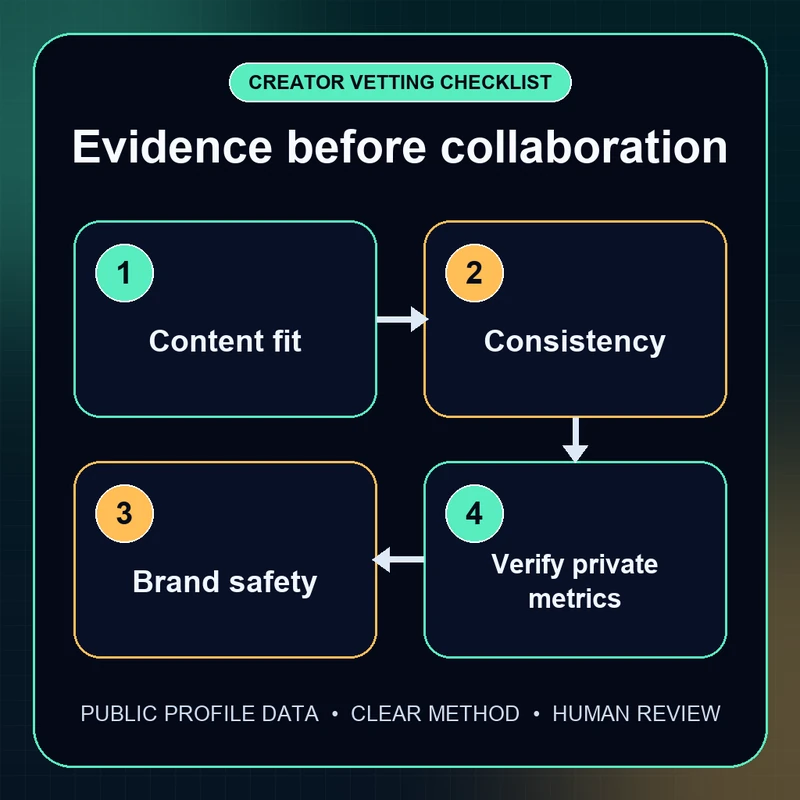
A defensible way to vet a TikTok influencer before a brand collaboration is Content fit → Consistency → Brand safety → Verify private metrics. Public posts make the first screen evidence-based; creator analytics and contract terms close the gaps public data cannot answer. Keep the criteria explicit, document examples, and approve only when the audience, creative, risk, outcome evidence, and rights all match the campaign. Recheck every finalist immediately before contracting, especially when the original review is several weeks old, and record any material changes before the final agreement is issued.
![How to Analyze a Competitor’s TikTok Account: 30-Video Audit [2026]](/_next/image?url=https%3A%2F%2Fr2.cliptool.app%2Fblog-thumbnails%2Fhow-to-analyze-tiktok-competitors_800.webp&w=828&q=75)
![How to Find Top-Performing Videos on Any TikTok Account [2026]](/_next/image?url=https%3A%2F%2Fr2.cliptool.app%2Fblog-thumbnails%2Ffind-top-performing-videos-tiktok-account_800.webp&w=828&q=75)
![How to Repost a TikTok Without the Watermark: Reels, Shorts & Other Accounts [2026]](/_next/image?url=https%3A%2F%2Fr2.cliptool.app%2Fblog-thumbnails%2Fhow-to-repost-tiktok-without-watermark_800.webp&w=828&q=75)