Knowing how to analyze a competitor’s TikTok account means replacing a swipe session with a repeatable research method. The For You feed highlights exceptional posts and reflects your viewing history; it does not show the competitor’s normal output. A profile audit captures a consistent sample, compares the account with its own baseline, and turns creative observations into testable ideas.
This 30-video audit is built for organic TikTok research by brands, agencies, and creators. It is deliberately practical: three to five relevant accounts, roughly 24–50 recent posts per account, one normalized spreadsheet, and a short list of hypotheses. It is not an ad-library review and it does not pretend that public views equal sales.

Quick answer: what belongs in a TikTok competitor audit?
Select three to five accounts serving a comparable audience. Collect the same recent window, normalize captions, dates, public metrics, hashtags, audio, and duration, then calculate median views, hit rate, and posting cadence. Tag hooks, formats, and content pillars. Finally, compare the profiles to identify patterns with evidence and gaps worth testing.
A good deliverable is not a giant inspiration folder. It is a concise answer to three questions: What does each competitor repeatedly publish? Which creative choices beat that account’s normal result? What audience need is underserved or poorly explained across the group?
| Metric | Working definition | Use in the audit |
|---|---|---|
| Median views | Middle view count in the sample | Typical account baseline |
| Hit rate | Share of posts above a defined threshold | Consistency of breakout content |
| Posting cadence | Posts per observed week | Experiment volume and rhythm |
| Content mix | Share of posts in each pillar | Strategic topic allocation |
| Share signal | Shares relative to the sample or views | Potential utility or identity value |
1. Define the decision before selecting competitors
“See what competitors are doing” is too broad. Decide whether the audit should improve hooks, launch a product pillar, refine posting cadence, or find a white-space topic. The decision determines which accounts belong in the set and which fields deserve manual tagging.
Write the research question at the top of the workbook. For example: “Which organic video formats consistently outperform for affordable home-fitness brands targeting beginners?” That wording excludes celebrity workout accounts with a different audience and gives reviewers a shared standard for content fit.
2. Choose three to five accounts that are actually comparable
Build a balanced set: direct commercial competitors, one aspirational publisher, and perhaps one adjacent creator who serves the same audience problem. Require recent activity and enough public posts. Document why each account was included—same category, price range, market, audience, or content promise.
Do not sort candidates by follower count and pick the biggest names. TikTok can distribute individual videos beyond a follower base, and a large publisher may have a production budget or celebrity advantage that your team cannot reproduce. Follower count is context; creative consistency and audience relevance make an account useful for comparison.
3. Collect a consistent 24–50-post window
Run each public username through TikTok Profile Scan on the same day. Begin with the 24 recent posts returned on the first page. Load 24 more when you need a broader cycle or when one account posts much less often than the others.
Fairness matters more than a perfect round number. If one brand publishes four times daily and another twice weekly, compare a similar date window and record the different post counts. Avoid full-history pulls unless the research question is historical; old strategies can hide what competitors are doing now.
The separate guide to finding top-performing videos on one TikTok account explains the single-profile ranking logic in depth. Here, that ranking becomes one input to a cross-account comparison.
4. Normalize the CSV before interpreting anything
Export each result and combine the files in one workbook. Keep account, video URL or ID, caption, publish date, views, likes, comments, shares, hashtags, audio note, and duration when available. Standardize date formats, numbers, and timezone. Add collection date so future readers know when the snapshot was taken.
Create controlled dropdowns for human labels. A basic taxonomy might include hook, format, content pillar, audience problem, proof type, call to action, and sound type. Without fixed labels, “talking head,” “talking-head,” and “person speaking to camera” split into separate categories and make the pivot table misleading.
5. Benchmark every account against itself first
Calculate median views for each account rather than ranking all raw views together. A global ranking mostly rewards account scale. A within-account baseline answers the more useful question: which posts unusually outperformed the publisher’s normal level?
Define a hit before reviewing the outcome. A simple rule is at least 2x that account’s median views. Hit rate is the number of qualifying videos divided by the sample size. The 2x threshold is a research convention, not an official TikTok benchmark; use 1.5x, a top quartile, or another rule when your category requires it, but keep the definition consistent.
Then add cadence. Count posts per week, average gaps, long pauses, and the frequency with which each format appears. A 20% hit rate across 60 monthly posts produces a different content engine from 20% across eight. Volume does not prove quality, but it explains how many experiments generated the observed winners.
6. Tag winners and a control sample
Watch every hit plus a selection of median and low-performing posts. Tag the opening hook, format, pillar, audio approach, proof, length band, and CTA. Reviewing only winners creates survivorship bias; ordinary videos reveal whether the same topic fails when the hook, evidence, or pacing changes.
Keep labels observable. “Strong hook” is an opinion; “shows final result in first second” is a reproducible description. “Authentic” is vague; “creator demonstrates product in an uncut bathroom routine” tells the production team what happened. Specific labels make cross-account patterns easier to defend.
TikTok One’s Top Content documentation offers another lens on trending material. Use it as external context, not a substitute for the competitor sample tied to your audience and market.
7. Build a content-gap matrix
Create a pivot table with competitors as columns and content pillars or audience problems as rows. Add post volume, median-relative winners, and notable formats. Look for needs that several accounts mention but explain poorly, as well as formats that one account has validated but others have not adapted.
A blank cell is not automatically an opportunity. Nobody may cover the topic because demand is weak, legal risk is high, or it sits outside the category. Validate the gap through search suggestions, customer interviews, support tickets, comment questions, or first-party query data before investing heavily.
Suppose every meal-prep competitor posts recipes, but only one consistently answers “cost per serving” with on-screen receipts—and those posts repeatedly exceed its median. The gap is not simply “more recipes.” It may be transparent budget proof for a cost-conscious audience. That is a sharper, testable creative territory.
Broad industry guides from Sprout Social, Metricool, and Socialinsider provide useful strategic context. ClipTool’s angle is the operational layer: recent profile data, a normalized CSV, and evidence attached to each conclusion.
8. Convert observations into testable hypotheses
Use an “If–then–because” structure. For example: “If we open beginner tutorials with the finished result before naming the three steps, more posts may exceed our median because that sequence appears in 8 of 12 competitor hits.” The statement identifies a change, an expected outcome, and supporting evidence.
Create a backlog with hypothesis, audience problem, hook, format, owner, publish date, and evaluation metric. Test a small number of changes at once. If you alter the topic, host, length, sound, CTA, and edit style simultaneously, you cannot learn which element mattered.
After publishing, compare results with your own account baseline—not the competitor’s raw view count. The goal of research is to improve your content system, not imitate someone else’s scale. Update the workbook after a campaign or monthly if your category moves quickly.
A practical 30-video audit checklist
- Write the decision and selection rules before opening profiles.
- Select three to five direct, aspirational, or adjacent accounts.
- Collect a consistent recent window and record the snapshot date.
- Normalize fields and apply one controlled creative taxonomy.
- Calculate account-level median, hit rate, and cadence.
- Watch hits and control posts, then build a gap matrix.
- Produce three to five hypotheses with attached video evidence.
If the creative team needs offline references, select only the approved examples and use the batch video downloader. Name files with account, date, and insight, and keep the original profile link in the workbook so provenance is not lost.
Rights, ethics, and analytical limits
Public availability does not grant permission to copy footage, scripts, characters, or a creator’s distinctive execution. Study the structure and audience need, then create original work using your brand’s evidence and voice. Obtain permission before redistributing another creator’s video outside a narrowly controlled research context.
If the account is yours, follow the own-video download and backup workflow so research copies do not become an accidental rights shortcut for third-party footage.
Public profiles cannot reveal retention, watch time, audience geography, conversions, paid amplification, production costs, or the objective behind a post. Metrics can continue to change, deleted posts disappear, and external publicity may distort performance. Present findings as evidence-backed hypotheses, not proof of revenue or causation.
FAQ
How many videos should a competitor audit include?
About 24–50 recent posts per account is usually workable. Use a comparable date range when publishing frequency differs sharply.
Can I analyze a private TikTok competitor?
No. This workflow is limited to public accounts and posts and should never be used to bypass privacy controls.
What is a good TikTok hit rate?
There is no universal standard. Define a hit relative to each account’s median, state the threshold, and compare using the same method.
Should we copy the formats that competitors use?
Learn the mechanism and test an original execution. Do not copy footage, scripts, or distinctive creative assets without permission.
How often should the audit be refreshed?
Monthly or before a major campaign works for active categories. Refresh sooner after a clear positioning, product, or cadence change.
Conclusion
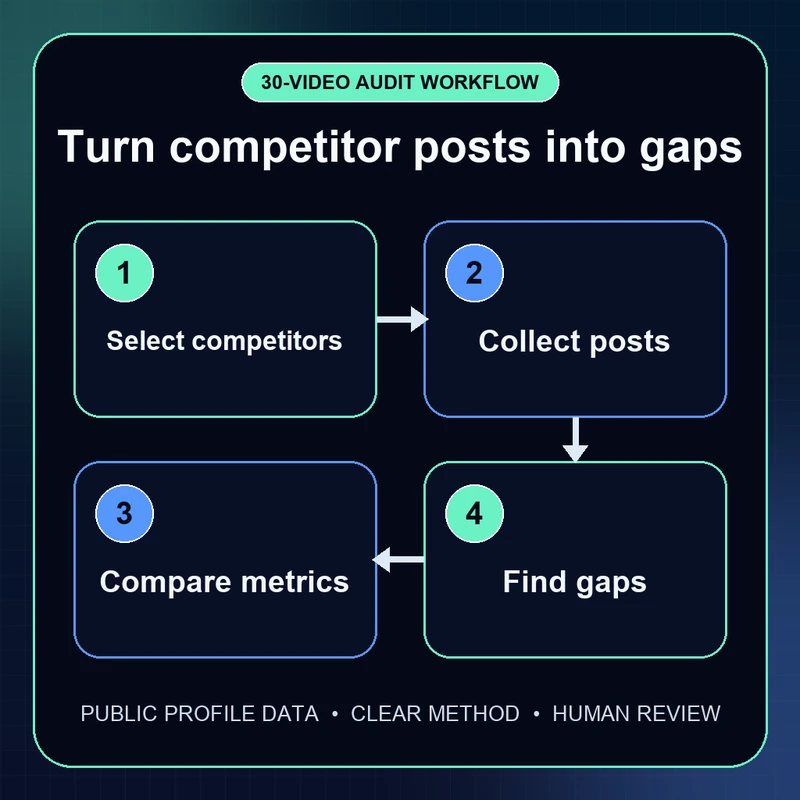
To analyze a competitor’s TikTok account well, follow Select competitors → Collect posts → Compare metrics → Find gaps. A normalized 30-video sample with transparent definitions will beat a folder of random viral clips. Use the findings to design original, measurable experiments for the next sprint, then let your own account data decide which ideas deserve another round.
![How to Vet a TikTok Influencer Before a Brand Collaboration [2026]](/_next/image?url=https%3A%2F%2Fr2.cliptool.app%2Fblog-thumbnails%2Fhow-to-vet-tiktok-influencer_800.webp&w=828&q=75)
![How to Find Top-Performing Videos on Any TikTok Account [2026]](/_next/image?url=https%3A%2F%2Fr2.cliptool.app%2Fblog-thumbnails%2Ffind-top-performing-videos-tiktok-account_800.webp&w=828&q=75)
![How to Repost a TikTok Without the Watermark: Reels, Shorts & Other Accounts [2026]](/_next/image?url=https%3A%2F%2Fr2.cliptool.app%2Fblog-thumbnails%2Fhow-to-repost-tiktok-without-watermark_800.webp&w=828&q=75)